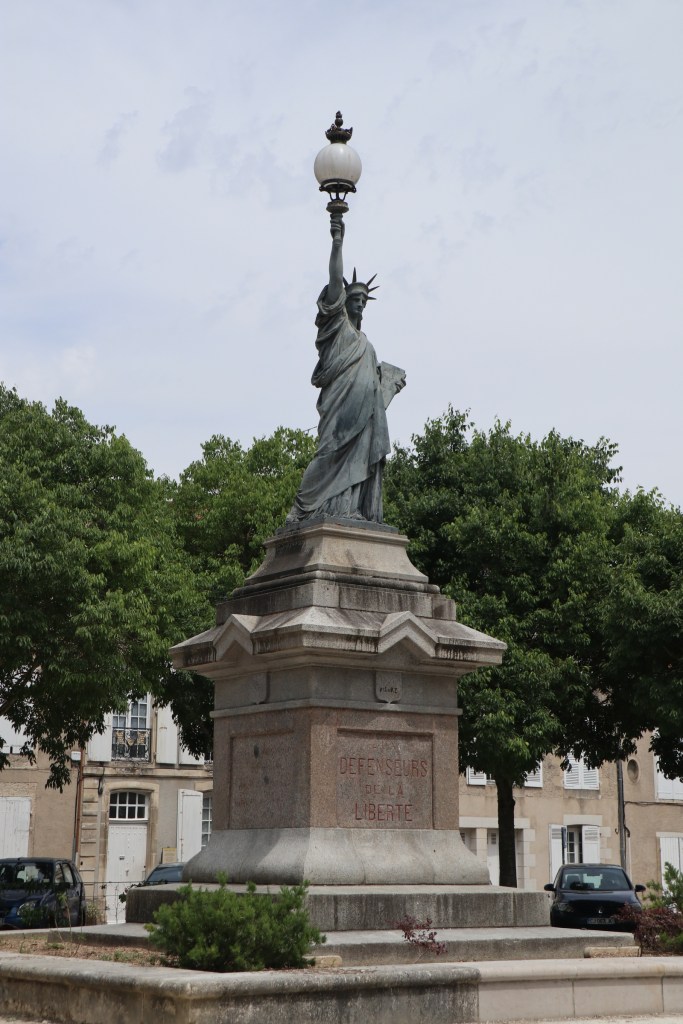
In the quiet leafy streets of Poitiers lies the Place de La Liberté, a small square with a scale replica of La Liberté éclairant le monde – or the Statue of Liberty as she is more commonly known. In her hand she holds a sheaf of stone papers with “07.1789 – 07.1903” chiselled into the top page. What’s all this about?
I was curious about the latter of the two dates. Of course, 1789 was the year of the French Revolution, and has been immortalised in various statues, town halls, and café names across France (I am thinking here of Café 1789 in Paris). July 14th saw the storming of the Bastille in France, and the year was no less important for the United States, with Washington inaugurated 75 days earlier in April (you can thank Hamilton for me knowing anything about US history). But what about 1903? A cursory Google search has informed me that 1903 was the year in which Emma Lazarus’ now iconic poem, “The New Colossus”, was inscribed on a plaque at the statue’s base:
Not like the brazen giant of Greek fame,
With conquering limbs astride from land to land;
Here at our sea-washed, sunset gates shall stand
A mighty woman with a torch, whose flame
Is the imprisoned lightning, and her name
Mother of Exiles. From her beacon-hand
Glows world-wide welcome; her mild eyes command
The air-bridged harbor that twin cities frame.“Keep, ancient lands, your storied pomp!” cries she
Emma Lazarus, The New Colossus, 1883
With silent lips. “Give me your tired, your poor,
Your huddled masses yearning to breathe free,
The wretched refuse of your teeming shore.
Send these, the homeless, tempest-tost to me,
I lift my lamp beside the golden door!”
Lazarus had written the sonnet two decades prior to its immortalisation on the base of Lady Liberty. I think this is the most likely explanation as to why 1903 is the year chiselled into the stone. Further research into 1903 in French history indicates little aside from the first Tour de France which started on July 1st (iconic, yes, but not really to do with liberty) and the Paris Metro fire which occurred in August.
If anyone knows more about this, feel free to correct me in the comments, I would love to learn more. For now though, I leave you with another of Lazarus’ poems about a famous woman in French art, and encourage you to read more of her poetry than just the piece she is most known for. I think you will like it.
Down the long hall she glistens like a star,
The foam-born mother of Love, transfixed to stone,
Yet none the less immortal, breathing on.
Time’s brutal hand hath maimed but could not mar.
When first the enthralled enchantress from afar
Dazzled mine eyes, I saw not her alone,
Serenely poised on her world-worshipped throne,
As when she guided once her dove-drawn car,—
But at her feet a pale, death-stricken Jew,
Her life adorer, sobbed farewell to love.
Here Heine wept! Here still he weeps anew,
Nor ever shall his shadow lift or move,
While mourns one ardent heart, one poet-brain,
For vanished Hellas and Hebraic pain.Emma Lazarus, 1849-1887, Venus of the Louvre
À bientôt,
Iona xx
 J'ai Dit "Oui"
Leave a comment