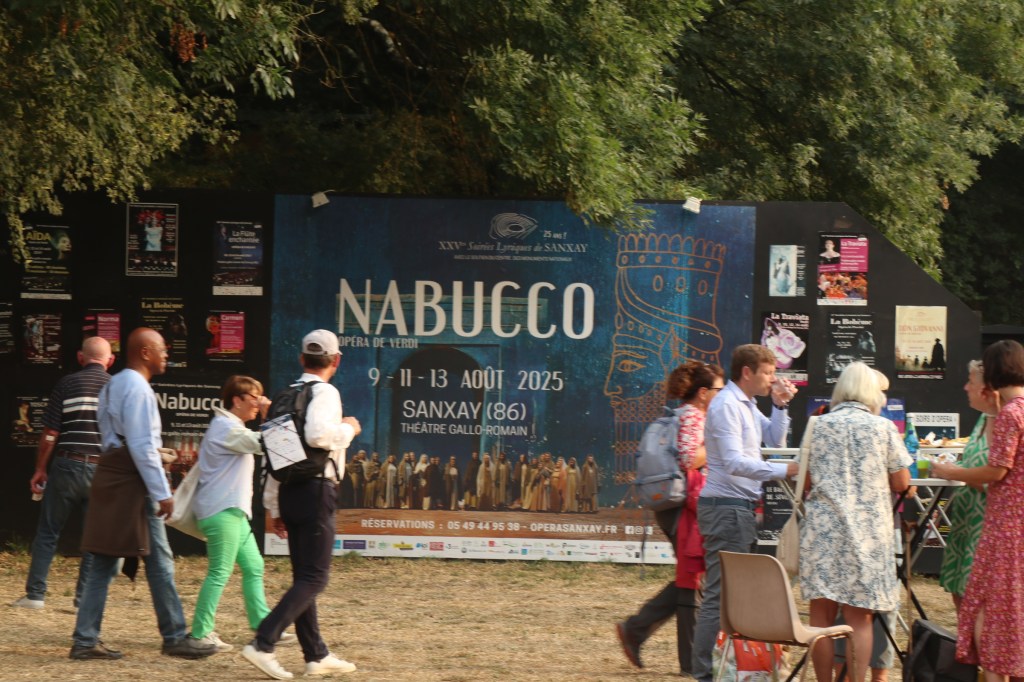
Bonjour all! It’s been quite a while, eh? Well, as I write it’s the end of my first week in Poitiers, and it’s been a week of many contradictory emotions: excitement, boredom, loneliness, joy… but I’ll get to those in another post. This one is about something extraordinary that I experienced on Wednesday night: Verdi’s Nabucco performed in the open air at Sanxay.
The Venue
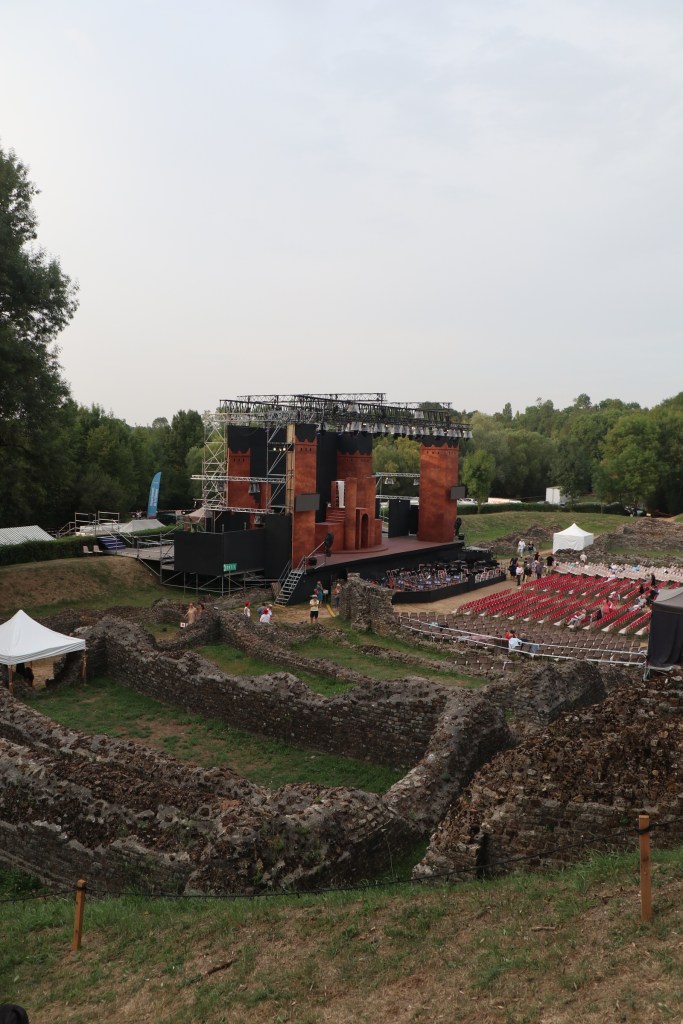
Sanxay is the remains of a Gallo-Roman theatre in the middle of the countryside, remote and wildly beautiful. Seeing the hedgerows pass by on the bus journey from Poitiers, I was reminded of growing up in Sussex, and of driving to Glyndebourne with my family to watch final dress rehearsals of their productions. It seems like beauty is conducive to opera.
Chosen 25 years ago by Christophe Blugeon, artistic director of the “Soirees Lyriques” at Sanxay, the ruins of the ancient theatre are once again brought to life each summer with lights, costumes and music from the talented performers. The next production is slated to be Mozart’s The Magic Flute, which brought great applause from the audience upon its anouncement. I must admit it is one of my favourite operas too, and if I’m still in France by the time it comes around I would be very excited to see their production of it.
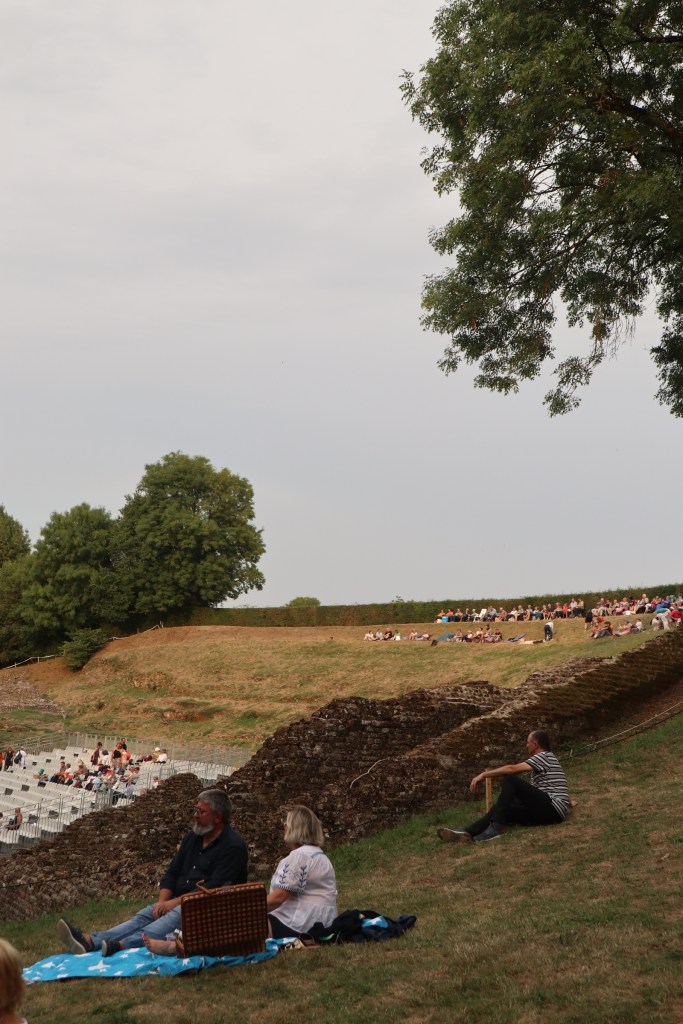
There were several seating options, al of which were half their original price if you were under 28, which was a very big factor in me deciding to go on the spur of the moment. The cheapest seats are on the “rim” of the “bowl” of the theatre, where you could bring your own picnic chairs or cushions and watch the opera from high above. Then there were the graduated levels within the “bowl” itself, which middle and side view seats (which are not plush like a theatre, but hard plastic: bring a cushion!)
Nabucco
Nabucco, composed by Guiseppe Verdi in 1842 at just 29 years old (so it seems I have about 5 years to get my act together) follows the the King of Assyria, the titular Nabucco, as he loses and then regains his mind. The persecutuion of Jews by the Assyrians in the play is the central conflict, with one of Nabucco’s daughters (Fenena) converting to Judaism and his other duaghter (Abigaille) seizing the throne and ruling with an iron fist and spurned heart, as Fenena’s lover Ismaele is the unrequited object of Abigaille’s own affections. The programme I bought gave a very helpful overview of each of the four acts which I had a little read through before the performance started.
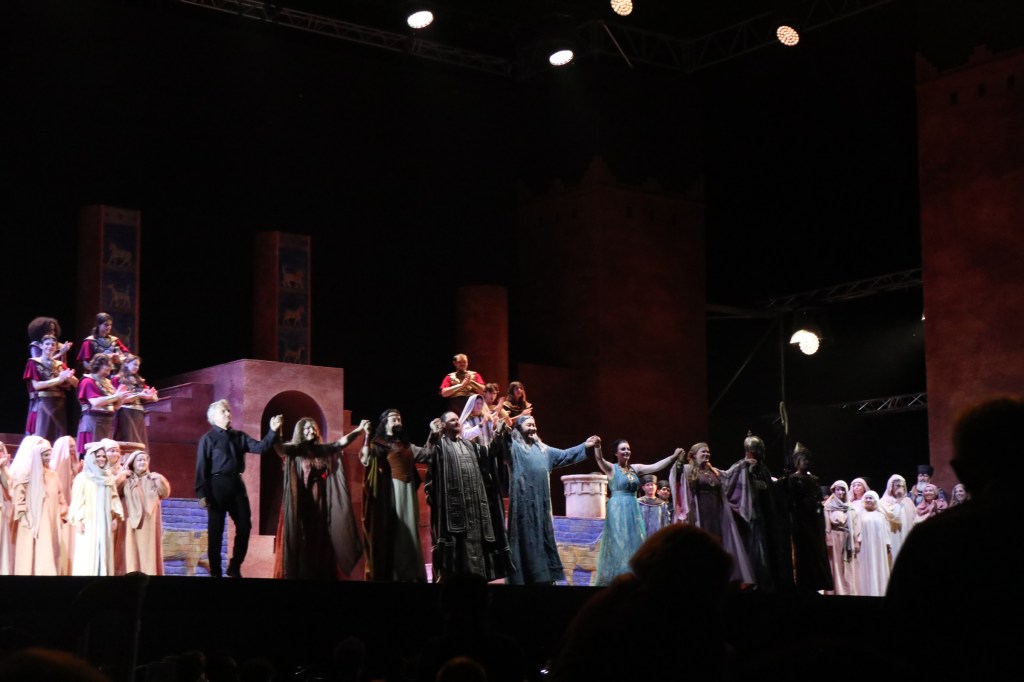
The whole production was fantastic. From the set design and lighting (Andrea Tocchio) to the costumes (Anna Biagiotti), the stage was transformed into first a synagogue, then an Assyrian palace, with excellent fluidity. I noticed that they employed a similar “turning stage” to that which I’d first seen at Glyndebourne, using the same set piece from different angles to become both dungeon and palace stairs. An excellent technique for an open-air production which enjoys few of the same luxuries for set creation as more traditional theatres.
The orchestra and group performances were both fantastic, led by Valerio Galli and Stefano Visconti respectively, especially important to Nabucco as its most famous song, the Song of The Slaves, is an ensemble performance from the persecuted and imprisoned Jewish characters. The standout for me from among the main cast was Ewa Vesin as Abigaille, and from the cheers she got as she appeared on stage for her bow, the audience agreed with me. She performed fantastically with what seemed to be some incredibly technically difficult arias, jumping from head voice down to chest and then back up again. It was amazing to watch.
One thing I will say is that the music itself does not have as much variety as some other operas: by that I mean it all feels to be on a similar level in its intensity and how emotional it is. There isn’t the variation between light heartedness and danger that one can find in other operas, but I think that was just the similarity of the music itself and not down to the performers. I remarked to the lady I sat next to on the bus ride back, who herself mentioned that the music was “vraiment dur”, that Abigaille’s part felt similar to the Queen of The Night Aria in terms of her anger and the difficulty of performing it, which she agreed with. So maybe this is more of an opera for the real Verdi lovers than the casual audience member like me, but I enjoyed it nevertheless.
The Set Up
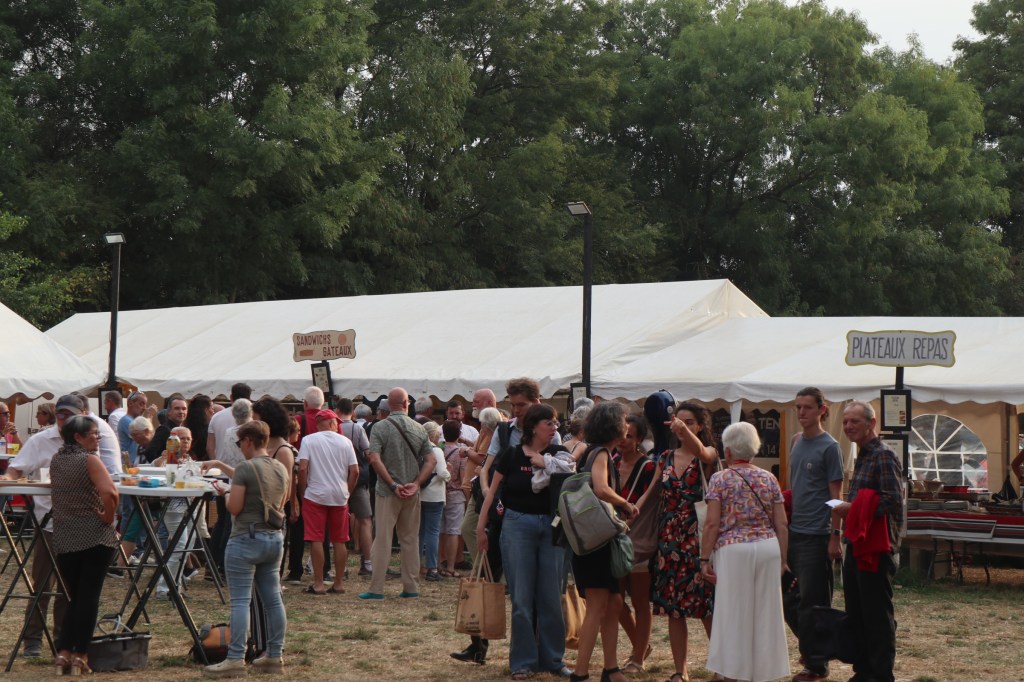
The whole thing was, as my mum would say, so low-key! There were gazebos set up, as you can see in the picture here, selling everything from champagne and oysters to microwaved crepes and hot dogs. The funny thing was the real mingling of people from the champagne bar to the hot dog stand and vice versa. Fine wine was drunk alongside packed sandwhiches wrapped in foil. The whole thing was so wonderfully unpretentious!
I reserved a place on the shuttle bus which went directly from the Poitiers bus station to Sanxay, getting the same one back. It was meant to be four euros overall (or two for a one way if you’re meeting a friend there and they’re driving you back) but they never did end up charging me. Buses are free here every Saturday (oh my gosh!) so the Saturday shuttle was free as standard too, according to the website. You just had to call to reserve a seat. It was excellent, and as someone unable to drive it made the process of going to Sanxay extremely easy and hassle free (although I did only make it at the last minute after sprinting because I’d underestimated how long it would take me to get to the bus station! But that’s a me problem really). Important information: the bus gets to Sanxay at about 19.20 and the performance starts 2 hours later, so it’s a good idea to bring a book or something to read in the meantime if you’re own your own like me.
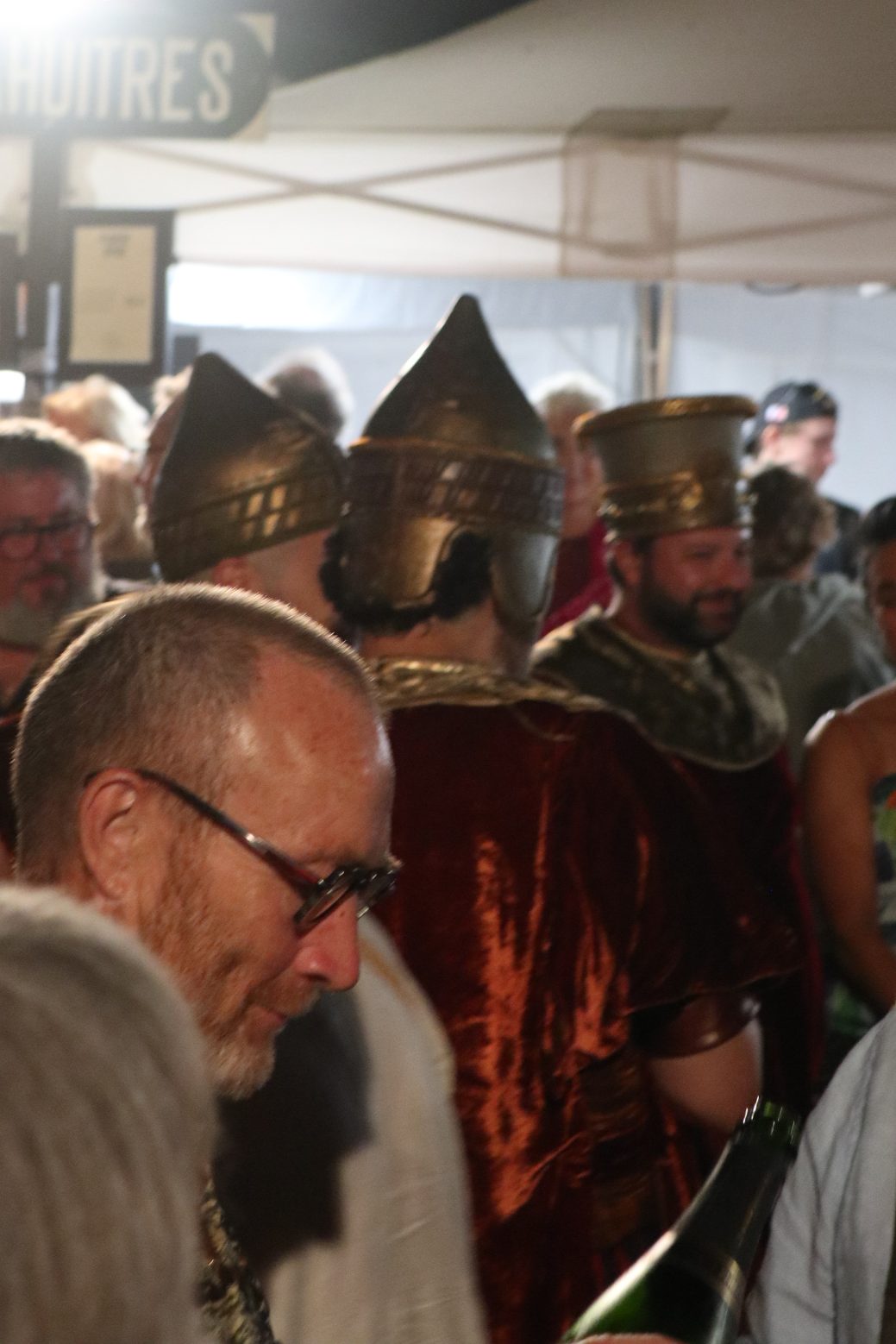
The man checking off our names on the list was himself an ensemble member, which I only realised when he showed up at the door of the bus back still in his Assyrian soldier costume. The whole thing felt so incredibly community led, with lots of volunteers manning the food stalls and selling programmes, and cast members chatting with friends and drinking a beer during the interval.
The Philosophy of Magic
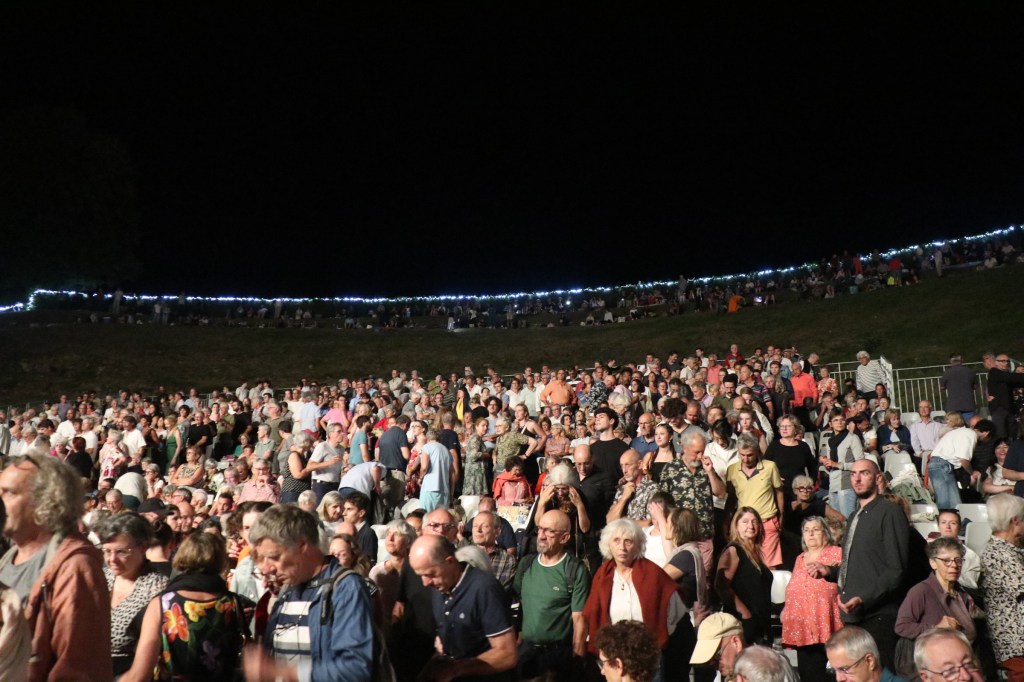
You may have noticed that I referred to the opera not even starting until around half past nine at night. By the time the shuttle bus got back to Poitiers, it was two am and I was ready to sleep (actually, I had started to on the ride home). However, there is a method to this madness. The philosophy underpinning the Soirees Lyriques at Sanxay is that in addition to the open air venue, which imparts its own magic, the best time for performance is the night, as this is the time when “the real and the fantasy meld into one” (I am paraphrasing – and translating – the president of the organisation here, who spoke on stage before the opera began). I love this idea. The idea that art is not to be put on at the most convenient hour, but at the hour when reality and fantasy are separated by only the thinnest veil. I think that speaks to the respect which everyone involved has for the art which they’re creating: it commands its own time, and they obey its command.
This idea of the magical, the “hour of the fey” (that’s from the lovely former teacher I sat next to on the bus ride back), is something that feels unique to life here, away from the busier cities of France. As my bus neighbour said, “the opera in Paris would not start at ten pm, or the opera in London. Out here we have the time for magic”. How lovely a mindset to have. I will endeavour to try and make a bit more time for magic. I think this was an excellent first step.
À bientôt,
Iona xx
 J'ai Dit "Oui"
Leave a comment